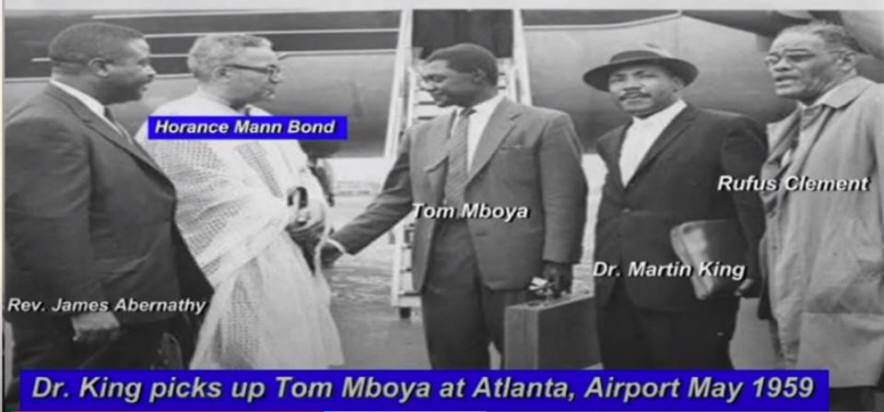
On August 15, 1956, a 26-year-old visionary named **Tom Mboya** arrived in America, fundamentally changing the course of both Kenyan and American history. Sponsored by the **American Committee on Africa (ACOA)** Tom Mboya's arrival was the catalyst for a bridge of solidarity that most history books have since burned. While his primary mission was to inform the West about the oppressive conditions in British East Africa, it was the leaders of Black America—A. Philip Randolph, Dr. Martin Luther King Jr., and others—who recognized that the independence of Africa was the global front of the American Civil Rights Movement.
Mboya did not have the institutional power to elevate himself in a colonial state; it was **A. Philip Randolph**, the leader of the AFL-CIO, who issued him a **$35,000 check** to build a Union Hall in Nairobi. This was the first brick in the foundation of Mboya's leadership, providing the only legal platform for Africans to organize under the shadow of British bayonets.
By 1958, Mboya's influence had expanded across the Atlantic. He was invited to **Ghana** as the Chairman of the historic **All-African Peoples' Conference** in Accra. This event was a crossroads where African freedom fighters met Black American activists, cementing the "Monroe Doctrine of Africa"—the idea that the continent belonged to its people.
Mboya's presence was so commanding that he became the face of a rising continent. Returning to the U.S. in 1959, he embarked on a tour that saw him honored at an African Freedom Dinner on May 13th, where Dr. Martin Luther King Jr. famously introduced him, declaring that their struggles were caught in an "inescapable network of mutuality." In mid-April of that year, Mboya's voice rang out alongside King's at rallies across the country. On **April 18, 1959**, he addressed over 20,000 people at the **Youth March for Integrated Schools** at the Washington Monument, standing with King, Randolph, and Harry Belafonte to demand the implementation of *Brown v. Board of Education*.
The depth of this relationship was best represented by the **African Airlift**, which was made possible only through the cultural and financial might of Black icons. Singer **Harry Belafonte**, baseball legend **Jackie Robinson**, and actor **Sidney Poitier** put their names on the line to raise the airfare for Kenyan students to study in America. This initiative brought the first wave of educated Kenyans to the West, including the father of a future U.S. President.
Parallel to this educational revolution was a legal one: **Thurgood Marshall**, the architect of the *Brown v. Board* victory, was invited by Mboya to draft Kenya’s **Bill of Rights and Constitution**. Marshall, a Black American, became an "actual framer" of the Kenyan nation, negotiating the protections of property and equality that were intended to ensure a peaceful transition from colonial rule to democracy.
However, the light of this alliance was dimmed by a series of political assassinations—JFK in 1963, Malcolm X in 1965, and both Dr. King and Robert Kennedy in 1968. The final blow came on **July 5, 1969**, when **Tom Mboya was assassinated** in Nairobi. Following his death, the Kenyan government under Jomo Kenyatta began a systematic and "racist" act of historical erasure.
To secure a narrow vision of national power, the post-Mboya administration effectively silenced the story of the Black American contribution. They buried the fact that a Black American wrote their Bill of Rights and that Black American unions funded their independence. This silence placed a wedge between Black America and Kenya, leaving generations of youth in both nations ignorant of the most significant African influence on American culture and the most significant American influence on African liberation.
Today, the truth is being resurrected by **Anthony "Amp" Elmore**, the "Father of Black Memphis History." A five-time World Kickboxing Champion and African Cultural Diplomat, Elmore has taken up the mantle that both Kenya and the U.S. dropped.
He is fighting to correct this history by establishing the **Tom Mboya and African/African American Education and Culture Center** in Kenya—the largest of its kind—to honor the union of Dr. King and Mboya.
Anthony "Amp" Elmore's vision is to designate **Orange Mound, Memphis**, as the **Tom Mboya Legacy District**, a sacred site where the story of "Airlift America" and the Marshall Constitution are taught. Through his upcoming film and cultural initiatives, Anthony "Amp" Elmore is shaming the silence and ensuring that the world finally knows: Kenya's freedom was funded by the heart and soul of Black America.