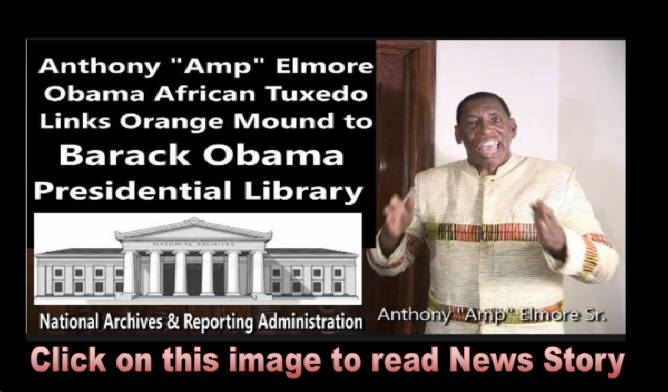
Let me tell you about me. My name is Anthony "Amp" Elmore. One of my greatest dreams in life was having the opportunity to visit Africa. Unknown and untold there is a unique spirit that exists in Kenya. One would have to understand the history of Kenya to understand this spirit.
In Kenya I was never recognizied as a Black man, but as an American. Kenya and Kenyan award the highest respect and honor to Americans. Perhaps it could have been in 1990 that Kenyans have not seen many Americans or rather "Black Americans."
There is a huge difference between treatment as a Black man in Kenya and treatment as a Blackman in Ghana. In Kenya I was able meet everyone from the President to the Massai in Kenya. There was something more that Kenyans have that is unknown, untold and unrecognized in kenya.
The foundational infrastructure and the very spirit of the modern Kenyan state were not accidental by products of colonial exit, but were the deliberate, strategic blueprints of Tom Mboya, the visionary architect of Kenyan independence.
While the British government had systematically engineered a "knowledge void" to maintain control, Mboya countered this by designing the 1956–1960 "Airlift Africa" as a state-building mission rather than a simple scholarship program. This initiative effectively bypassed colonial gatekeepers to create a professional class of doctors, engineers, and diplomats—the "Airlift Generation"—who returned to fill the leadership vacuum in 1963.
The foundational infrastructure and the very spirit of the modern Kenyan state were not accidental byproducts of colonial exit, but were the deliberate, strategic blueprints of Tom Mboya, the visionary architect of Kenyan independence. While the British government had systematically engineered a "knowledge void" to maintain control, Mboya countered this by designing the 1956–1960 "Airlift Africa" as a state-building mission rather than a simple scholarship program. This initiative effectively bypassed colonial gatekeepers to create a professional class of doctors, engineers, and diplomats—the "Airlift Generation"—who returned to fill the leadership vacuum in 1963.
Click here to video titled: Harry Belafonte, Tom Mboya Barack Obama Connection.
This video gives a clear understanding of the history of Kenya.What is not told about Kenya is that the history of Tom Mboya has been erased. This website not only challenges the erasure of the history of Tom Mboya we point the harm and devestation this has on African and African/American relationships.
Anthony "Amp" Elmore notes that he was inspired by the spirit of Tom Mboya whereas the spirit of Tom Mboya told Anthony "Amp" Elmore to contact his people and they would believe him and assist.
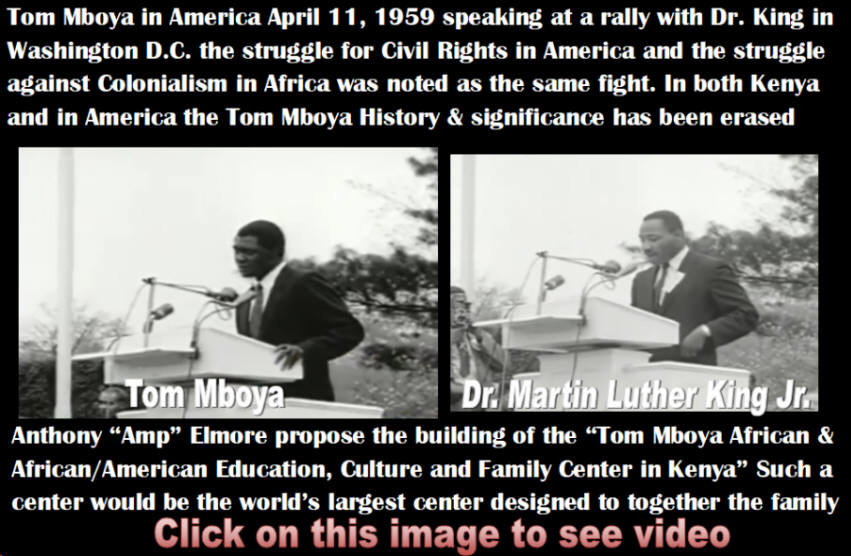
Below in 1959 Tom Mboya speak at "The Youth Rally" in Washington D.C. Youth in American would be proud to support a center that joins both Africans and African Americans and tell the history how both Black and White leaders helped to birth Kenya via the civil rights movement in America that lead to Barack Obama Jr. becoming America's 1st Black President.


The void of African heroes in the American educational landscape has indeed left a profound gap in the collective identity of the African Diaspora. While figures like **Jomo Kenyatta** or the **Mau Mau Uprising** occasionally surfaced in cultural consciousness as symbols of resistance, they often felt like distant, abstract revolutionary archetypes rather than tangible partners in the struggle for dignity.
This lack of a relatable African protagonist meant that for many African Americans, Africa remained a place of "ancient history" or "colonial struggle" rather than a source of modern, intellectual, and political synergy. **Tom Mboya** represents the most tragic example of this "missing link," as his influence was not merely symbolic but deeply structural, directly weaving the destinies of Kenya and Black America together during the height of the Civil Rights Movement.
Mboya was a visionary who understood that the liberation of the African continent and the liberation of Black Americans were two sides of the same coin. His most enduring contribution to American history was the **"Airlift Africa"** project (often called the Kennedy Airlift), which he coordinated alongside mentors like **A. Philip Randolph** and celebrities like **Harry Belafonte.**.
This program brought hundreds of East African students to American universities to gain the skills necessary to lead a post-colonial Kenya. Most notably, this program brought **Barack Obama Sr.** to the United States; without Mboya’s logistical brilliance and his ability to lobby the Kennedy family, the 44th President of the United States would likely never have been born. Mboya was a charismatic, Western-savvy intellectual who could hold his own on *Meet the Press* and build genuine friendships with **Martin Luther King Jr.**, bridging the gap between Pan-Africanism and the American quest for voting rights.
The "erasure" of Mboya, both in the United States and in his homeland, is a byproduct of political tragedy and the narrowing of historical narratives. In Kenya, his **1969 assassination** silenced a man who was widely seen as the most capable successor to Kenyatta, and the subsequent political climate—often divided along ethnic lines—found it more convenient to center the national story around a single "founding father" rather than the pluralistic, cosmopolitan vision Mboya championed.
In America, the narrative of the 1960s often became strictly domestic, overlooking the internationalist collaborations that defined the era. Reclaiming Mboya’s story isn't just about adding a name to a list of heroes; it is about recognizing that the "Positive Story of Africa" was once a shared, active dialogue that fundamentally reshaped the American presidency and the global Black identity.
The website and mission led by **Anthony "Amp" Elmore** through platforms like the **Orange Mound News Network** and **BlackMemphisHistory.com** serve as a vital "voice in America" dedicated to reclaiming the legacy of **Tom Mboya**. This effort highlights Mboya as the indispensable "missing link" between the African independence movement and the American Civil Rights struggle.
By centering Mboya’s story, these platforms argue that the connection between Africans and African Americans is not just an abstract ancestral bond but a concrete political and educational partnership. Mboya’s 1956 arrival in the U.S. and his subsequent collaboration with figures like **A. Philip Randolph**, **Harry Belafonte**, and **Martin Luther King Jr.** created a blueprint for global Black solidarity that was far ahead of its time.
The "Airlift Africa" project remains the most tangible evidence of this connection, as it directly bridged the two continents by bringing East African students to American universities. This initiative did more than just provide education; it fundamentally altered the course of American history by bringing **Barack Obama Sr.** to the U.S., eventually leading to the election of the first African American president.
The work being done in Memphis to honor Mboya—such as the planned **"Tom Mboya 70th & 1st Black Family Reunion" in Kenya in 2026**—aims to restore this "erased" history to its rightful place. By acknowledging Mboya as a hero whose influence helped shape the presidencies of both **John F. Kennedy** and **Barack Obama**, the narrative moves away from a "void" of heroes toward a shared history of intellectual and revolutionary excellence.
Ultimately, the story of Tom Mboya provides a "Historical Pathway" for both Black and White Americans to reconnect with Africa through a lens of mutual progress and democratic values. While his work was tragically cut short by assassination and obscured by decades of political shifts in Kenya, his spirit is being revitalized in the Diaspora as a tool for cultural diplomacy. Reclaiming Mboya’s legacy is about more than just remembering a single man; it is about validating the historical reality that the liberation of the African continent and the advancement of Black America were always part of the same "inescapable network of mutuality."
Anthony "Amp" Elmore who lives in the African/American Memphis community of Orange Mound is dedicated to continuing the tasks of Dr. Martin Luther King Jr. and Tom Mboya at connecting Africans, African/Americans and Americans.